Link Building Email Templates: 5 Short Ones, Checked Against 62

We counted every first-contact template in nine popular guides: length, the ask, and whether it says why the link fits. Then we wrote five shorter ones.
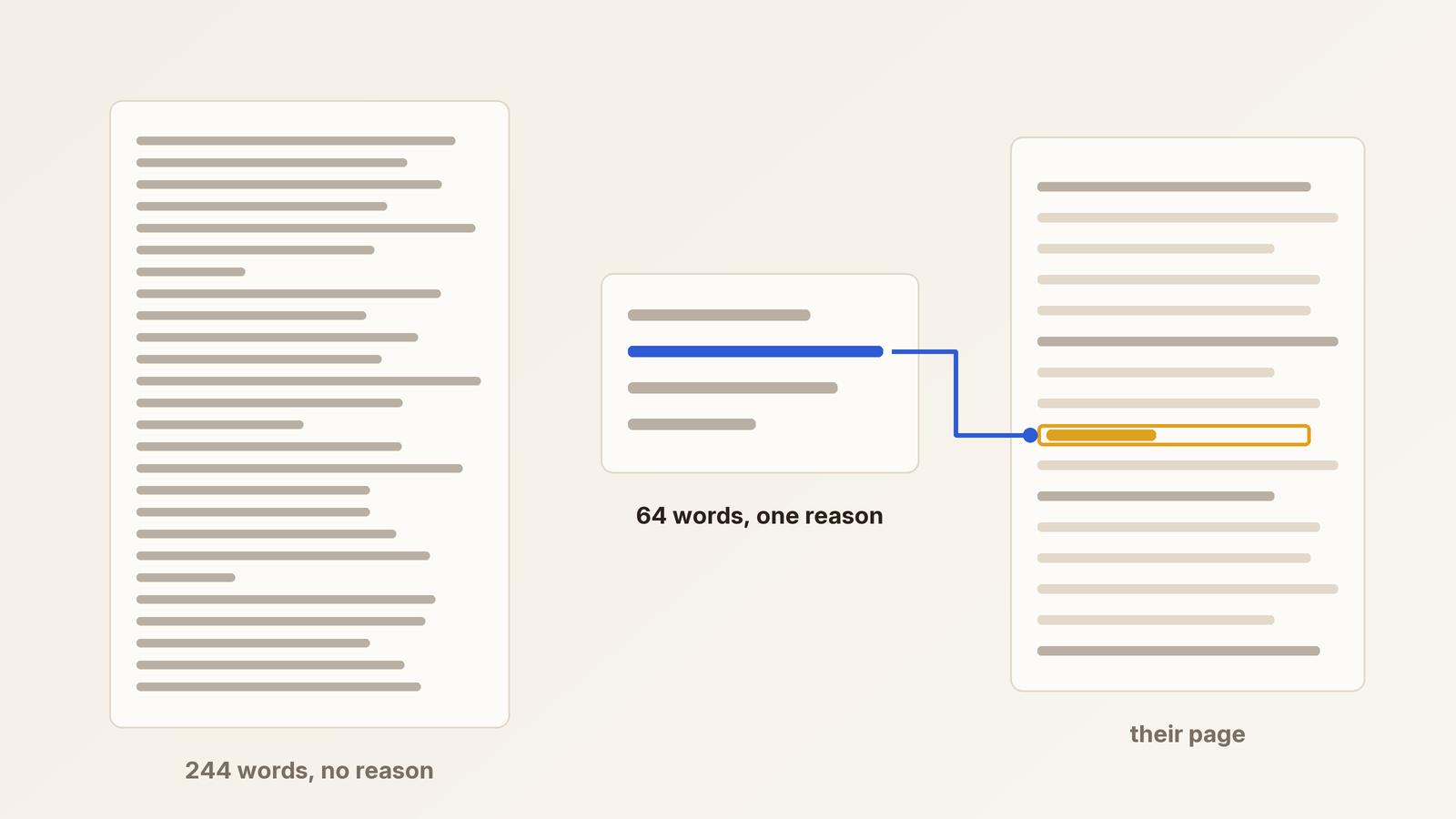
A link building email template works when it names one specific reason your link belongs on that exact page, stays under about 120 words, and asks for one small thing. Most template roundups hand you a long script and a promised reply rate. We read nine popular link building email template guides, counted what their 62 first-contact templates actually do, and wrote five shorter ones, one per tactic, that you can copy below.
What a link building email has to do#
The person you email owns a page. They will change it only if your link makes that page better for their readers, and they will decide in a few seconds. So the email has three jobs:
- Show you read the page. Name the article and the spot: the broken link, the section, the outdated stat.
- Say why your page fits there. One sentence on what your page adds that theirs is missing.
- Ask for one small thing. A swap, an addition, or permission to send a draft. Not a link plus a share plus a call.
Everything else in a template is optional. If you want the wider process (prospecting, sequencing, tracking), it is in our link building outreach guide. This post is the emails: five templates first, then what we found in 62 published ones.
Five link building email templates by tactic#
Each template below is under 120 words, has one slot that names something on their page, and makes one ask. Fill the slots by hand. If you cannot fill the reason slot honestly, that prospect is not a fit, and no template will fix it.
1. Broken link template (62 words). The reason is their dead link. More on the tactic in our broken link building guide.
Subject: Broken link in your [article title]

Hi [Name],

In your [article title], the link to [broken URL] in the "[section name]" section now returns a 404.

We published [your page title] last [month]. It covers the same ground: [one line on what it covers that the dead page did].

If it's useful, here it is: [your URL]. Either way, the old link is worth removing.

Thanks,
[Your name]
2. Resource page template (64 words). The reason is a gap in their list. See resource page link building.
Subject: A [topic] resource for your [page name] list

Hi [Name],

Your [page name] is one of the few lists I've found that [specific thing it does well].

I noticed it has [N] links under "[section]" but nothing on [missing subtopic]. We wrote [your page title], which covers [what it covers] with [what makes it useful, e.g. a free template].

Would it be a fit for that section? [Your URL]

Thanks,
[Your name]
3. Unlinked mention template (52 words). The reason is that they already named you. More in link reclamation.
Subject: Thanks for mentioning [brand] in [article title]

Hi [Name],

Thanks for including [brand] in [article title]. [One specific line about why their point was right.]

The mention isn't linked at the moment. If you're open to it, [your URL] is the page your readers would want for [what they'd look for].

Either way, thanks for the mention.

[Your name]
4. Guest post pitch template (74 words). The reason is a topic their archive is missing. More in guest posting for backlinks.
Subject: Pitch: [working title]

Hi [Name],

I read [their recent post] and the follow-up question it leaves is [question]. Your archive doesn't seem to cover that yet.

I'd like to write [working title] for [site]: [one line on the angle], using [your data or experience that makes you the right person].

Previous writing: [link 1], [link 2].

Would you like a short outline? If the topic isn't right, I'm happy to take one from your list.

[Your name]
5. Content update template (64 words). The reason is a specific stat or claim that has aged. This is the honest version of the skyscraper technique.
Subject: Updated figure for your [article title]

Hi [Name],

Your [article title] cites [stat] from [source, year]. [Source] has since published [new figure / the original is no longer online].

We put together [your page title], which has [what's new: newer data, a method, a chart] and links to the original sources.

If you update that section, it might be a useful reference: [your URL].

Thanks for writing it,
[Your name]
Why they are short: what 62 published templates do#
We read nine guides that rank for link building email templates in October 2026: Woodpecker, HubSpot, MailMaestro, LSEO, Mailtrap, QuickMail, Yellow, Backlinko and Mailshake. We kept every first-contact email aimed at a link, guest post or mention (62 in total) and left out follow-ups and thank-you notes. For each one we counted the words from greeting to sign-off, with each [placeholder] as one word.
- Length varies sixfold. The shortest template is 40 words and the longest is 244. The median is 110.5 words, but 26 of the 62 run past 120.
- Short and specific are separate fixes. Backlinko's three templates are 59 to 64 words and all three name something on the recipient's page. Woodpecker's run 96 to 141 words and 10 of its 12 do too. Mailtrap's median is 163 words and only 4 of its 11 do.
- Every publisher sells something. All nine sell email, outreach or SEO software or services. That is normal for this keyword, so read each guide's advice with its product in mind.
Why the reason matters more than the wording#
Length is easy to fix. The bigger gap is that most templates never say why the link belongs on that particular page. We marked a template as having a page-specific reason only if it has a slot for one: their broken URL, a named section, a specific claim. "I loved your article on [topic]" did not count.
- 34 of 62 templates (55%) give no page-specific reason. In their place is usually general praise for the site or the writer.
- 42 of 62 ask for the link in the first email, either directly (asking them to add or swap the link) or softly ("it might be a good replacement," in Backlinko's words). 20 only offer something or ask permission to send it.
- The pattern we recommend, ask plus page-specific reason, is 24 of 62. Backlinko's three templates, 10 of Woodpecker's 12 and 4 of QuickMail's 6 have the reason slot. Where it is missing, longer templates tend to fill the space with praise for the site.
This lines up with the one large dataset any of these guides link to. Backlinko's 2019 study of 12 million outreach emails, run with data partner Pitchbox, found that only 8.5% got a response and that emails with personalized bodies had a 32.7% higher response rate. That is a correlation across all kinds of outreach, not a test of link requests, but it points the same way: the specific sentence is the one that earns the reply.
Want the reason written for every prospect? GenLink's agent reads each target page, finds where your link fits, and writes the one sentence that says why, then sends from your own domain.
Subject lines and follow-ups#
56 of the 62 templates come with a subject line, and the median is 47.5 characters. Backlinko's study found that subject lines of 36 to 50 characters had the best response rate in its data; 24 of the 56 sit in that range. Ours run from 22 to 48 characters before you fill the slots, and most land in that range once the article title is in.
The same study found that emailing a contact more than once led to twice as many responses. Only 7 follow-ups appear across the nine guides, so most leave you to write your own. Keep it to one line that adds something, such as "I also have a version with the 2026 figures if that's easier to link." Send one, perhaps two, then stop.
Two templates that can get your site in trouble#
Some published templates make the link part of a trade. Mailtrap's backlink request offers a "link exchange", and one of Yellow's templates asks for "a backlink included somewhere in the review as part of the agreement." Google's spam policies list "excessive link exchanges" and "exchanging goods or services for links" as link spam. A one-off swap between two relevant sites is not the same as a scheme, but a template built around the trade is a habit you want to avoid. Our reciprocal links post covers where that line sits.
Where template reply rates come from#
The guides quote nine reply, response or conversion rates. Seven name no source. Woodpecker's examples credit "one agency" and "one content team" without naming them. QuickMail says to "expect anywhere from 1% - 10% email to link conversion rate" without citing data. The two rates that do link to a source both link to the publisher's own material: Backlinko's study and a QuickMail customer case study (31% reply rate).
So treat any rate printed next to a template as a story, not a benchmark. Your own rate depends on the list more than the words. Track replies and links per template in your own sends, and compare like with like.
How to write your own link building outreach email in five steps#
- Open their page first. Find the one thing your link fixes there: a dead link, a gap, an old figure, an unlinked mention.
- Write the reason sentence. If it does not mention their page by name, rewrite it.
- Add one line on your page. What it covers that theirs is missing. No adjectives about your brand.
- Make one ask. A swap, an addition or "want the outline?" Not a share and a call as well.
- Cut to 120 words, then read it on a phone. If the reason is not visible without scrolling, move it up.
Frequently asked questions#
What is the best link building email template? The one with the most specific reason in it. A broken link template is the easiest to write well because the reason (their 404) is a fact they can check in seconds.
How long should a link building email be? Under about 120 words. The median of the 62 templates we counted is 110.5 words, and the shortest guides, such as Backlinko's at 59 to 64 words, are the ones with a specific reason in every template.
Should I ask for the link in the first email? Yes, if you can give a page-specific reason. Keep the ask small: a swap or an addition, not a list of requests. For guest posts, asking whether they want an outline works better than sending a full draft.
What reply rate should I expect from link building outreach? No guide we read gives an independent benchmark. Backlinko's 12-million-email study found 8.5% of all outreach emails got a response, across every kind of outreach. Measure your own by template and by list.
How many follow-ups should I send? One or two. Backlinko's data found more than one email to a contact doubled responses, but each follow-up should add something new, not repeat the ask.
Can I offer something in exchange for a link? Not as a trade. Google's spam policies treat exchanging goods, services or links for links as link spam. Offer something useful in the email, not as payment for the link.
Templates don't send themselves. GenLink's backlink agent finds the pages, writes each email around one reason, and follows up from your own domain. The free plan includes one agent.